
Why this work matters
Many refugee settlements rely on pit latrines but lack adequate systems for safely treating the waste they contain. Because displacement can last for years, temporary sanitation infrastructure must still provide durable protection for people and the environment.
The FSTU response
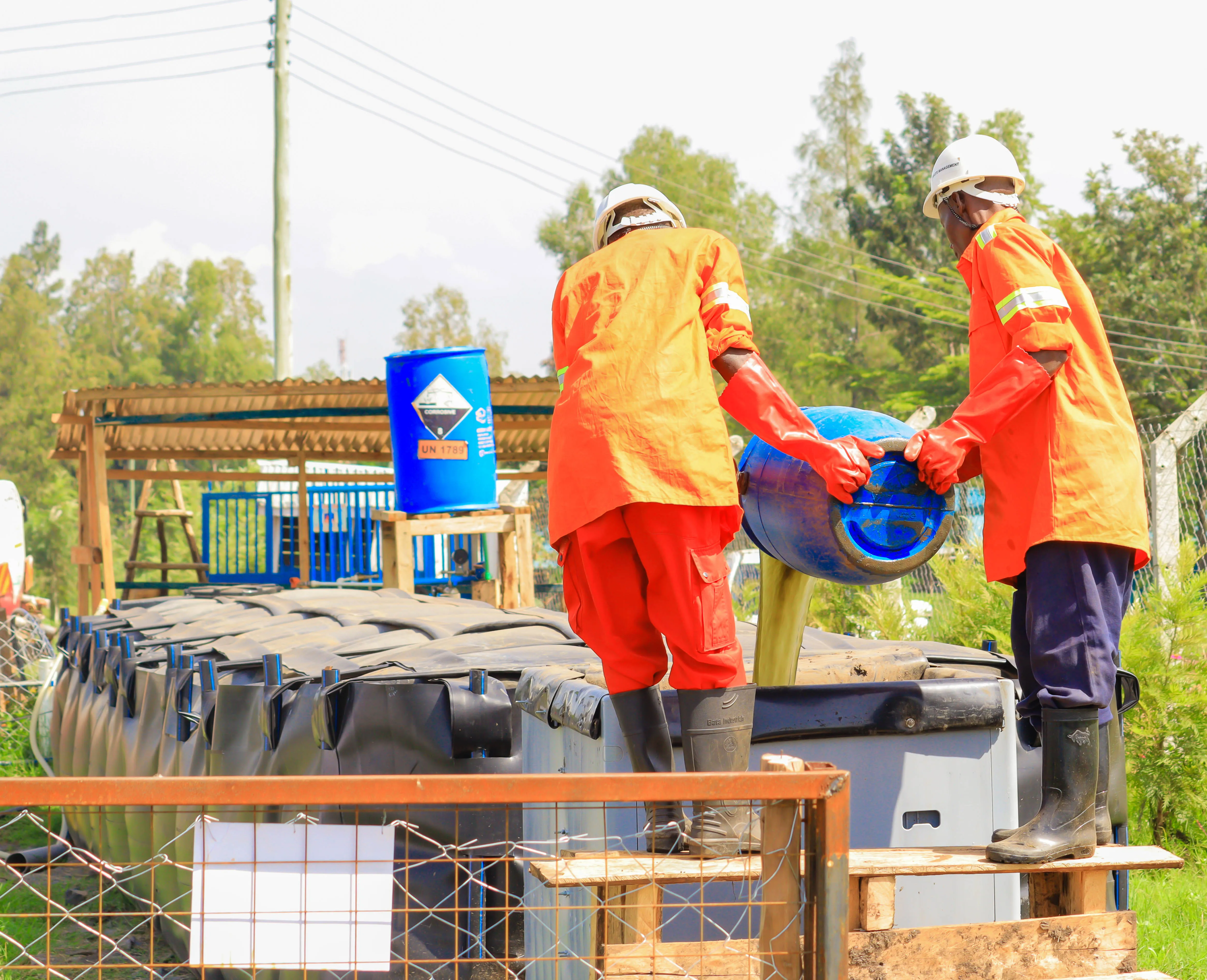
Opero developed and piloted the fecal sludge treatment unit at the Kisumu WASH Technology Hub with support from ETH Zurich, Sistema.bio and the Veolia Foundation.
The system pairs anaerobic treatment with thermal disinfection. Biogas generated in the first stage supplies energy to the second, reducing dependence on chemicals or an external fuel source.
Core system features
Anaerobic treatment
A Sistema.bio anaerobic reactor contains and treats fecal sludge while producing biogas as an output.
Thermal disinfection
The treated effluent moves through a controlled heating stage designed to remove pathogens while retaining useful nutrients.
Self-sustaining process
Biogas from the anaerobic stage powers thermal treatment, creating an integrated process without chemical disinfection.
Evidence from Kisumu
Figures below are drawn from Opero's published Saniforce pilot results.
- 115 m³
- Fecal sludge treated
- 15 months
- Pilot operating period
- 15 min
- Reported disinfection contact time
Project findings
Treatment performance
The published pilot reported complete pathogen removal at 60–70°C with a 15-minute contact time.
Environmental value
The earlier project results estimated 1,600 m³ of methane emissions avoided compared with decomposition in pits.
Operational learning
Fifteen months of operation in Kisumu generated practical evidence for adapting the unit to humanitarian contexts.
What the approach offers
- Designed for decentralized and humanitarian settings
- Uses energy recovered from the treatment process
- Avoids chemical disinfection requirements
- Produces a treated, nutrient-rich output